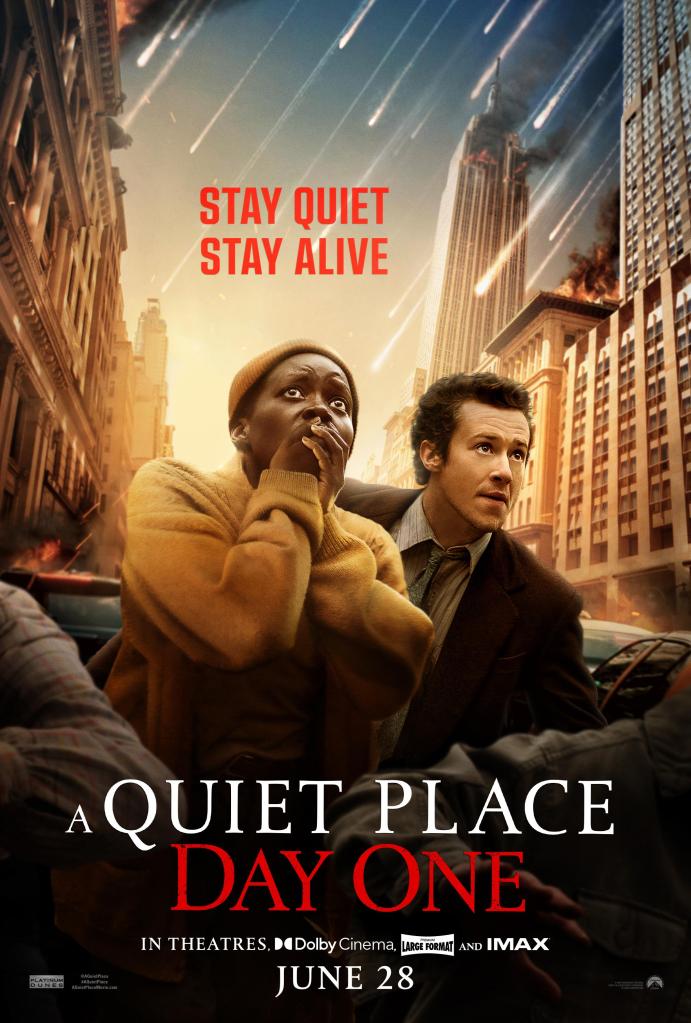
The “Quiet Place” franchise expands its eerie universe with “A Quiet Place: Day One,” a prequel that transports audiences back to the harrowing genesis of the alien invasion. Diverging from the established Abbott family narrative, this installment ventures into the chaotic, once-bustling streets of New York City, offering a fresh, character-driven perspective on the apocalyptic onset. Critics largely praise the film for its compelling performances, particularly from Lupita Nyong’o and Joseph Quinn, and its successful shift in thematic focus, even if some found it less about the initial carnage and more about human connection.
At its core, “Day One” is lauded for being “grounded in raw humanity” (Rotten Tomatoes consensus). Rather than solely focusing on the alien threat, director Michael Sarnoski (known for “Pig”) masterfully weaves a poignant tale of two strangers, Samira (Lupita Nyong’o) and Eric (Joseph Quinn), finding unexpected solace and purpose amidst the terrifying silence. Nyong’o’s portrayal of Samira, a character grappling with her own mortality even before the invasion, has been widely highlighted as a powerhouse performance, showcasing a heartbreaking vulnerability and resilience. Joseph Quinn, too, receives accolades for his nuanced depiction of Eric, a man lost and fearful who finds a path forward alongside Samira. Their chemistry is often cited as a major strength, carrying the emotional weight of the film.
The shift to an urban setting provides a new canvas for the franchise’s signature tension. While some viewers initially expected more large-scale destruction and the explicit “learning” process of silence that the first two films touched upon in their opening, “Day One” opts for a more intimate and claustrophobic experience within the city’s ruins. The concept of New York’s inherent 90-decibel hum suddenly falling silent, punctuated by sudden, fatal alien attacks, creates a unique and often relentless sense of dread. The sound design, a hallmark of the series, is once again praised as immaculate and integral to the storytelling, making every rustle and creak a source of terror.
However, the film isn’t without its critiques. Some reviewers felt that the “Day One” aspect, particularly the initial chaos and the revelation of how people adapted to silence, was glossed over or not explored to its full potential. The lack of new lore regarding the aliens’ origins or motivations was also a point of contention for some who sought more expansion of the universe. Additionally, while the character-driven narrative is celebrated, a few critics felt that the plot, at times, relied on conveniences or that the character development, particularly for Eric, could have been more fleshed out.
Despite these minor quibbles, the consensus remains overwhelmingly positive. “A Quiet Place: Day One” is seen as a worthy and refreshing addition to the franchise, proving that the concept can thrive beyond the original family unit. Its ability to balance nail-biting suspense with deeply affecting human drama, even prompting tears in some viewers, sets it apart. And, of course, no review would be complete without mentioning the breakout star who “steals the show”: Frodo the cat, whose quiet antics provide both comfort and unexpected moments of tension.
Ultimately, “A Quiet Place: Day One” delivers on its promise of a terrifying yet emotionally resonant journey, inviting audiences to experience the devastating beginnings of a silent world through a fresh lens and proving that even in the face of unimaginable terror, human connection and the pursuit of simple pleasures can offer a profound sense of hope.
