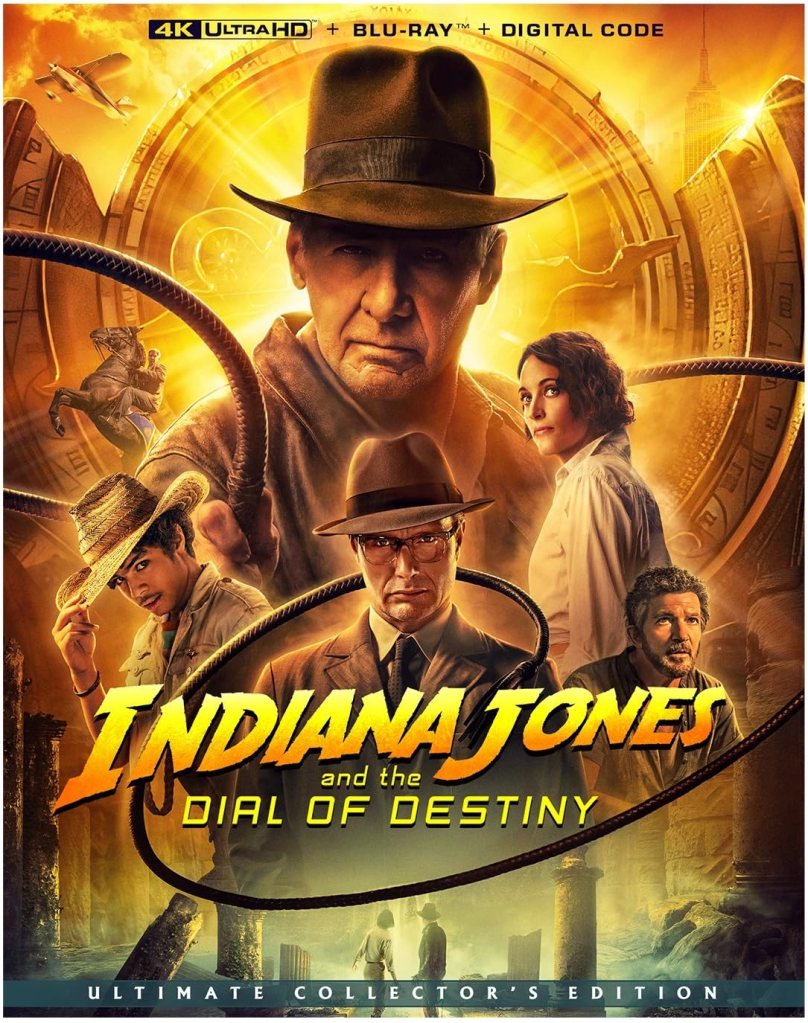
“Indiana Jones and the Dial of Destiny” delivers a poignant and exhilarating capstone to one of cinema’s most beloved franchises, proving that even a seasoned archaeologist can still uncover thrilling adventures and, more importantly, find his way back home. This film, the fifth and final installment, masterfully weaves new narratives with the rich tapestry of its predecessors, offering fans both fresh excitement and deeply satisfying closure.
At the heart of this final quest, of course, is the indomitable Indiana Jones, once again brought to life by the legendary Harrison Ford. Despite the passage of time, Ford still possesses that quintessential Indy charm, wit, and grit. The film wisely embraces his age, allowing it to inform the character’s weariness and reflections on a life lived on the edge, yet never diminishing his capacity for daring feats or quick thinking. Ford’s performance is a testament to his enduring talent, showcasing that “he’s still got it” in every sense of the word, whether he’s narrowly escaping danger or delivering a perfectly timed sardonic remark.
The narrative introduces compelling new characters who seamlessly integrate into Indy’s world. We meet Helena Shaw, played with cunning charm and a touch of mischief by Phoebe Waller-Bridge. Helena is Indy’s goddaughter, a resourceful and morally ambiguous accomplice who often pulls Indy into the very scrapes he tries to avoid. Their dynamic is a highlight, offering both comedic banter and genuine emotional connection. On the antagonist side, we have Dr. Voller, a former Nazi scientist obsessed with the titular Dial of Destiny, chillingly portrayed by Mads Mikkelsen. Mikkelsen’s cold intellect and sinister presence make him a truly formidable foe for Indy, echoing the classic Nazi villains of the earlier films. Other notable additions include Renaldo, a loyal friend of Indy’s played by Antonio Banderas, adding a fleeting but memorable moment of camaraderie.
The Plot: A Race Through Time for a Legendary Artifact
The film’s narrative begins in 1944, with a de-aged Indy (a remarkably executed visual effect) and his associate Basil Shaw (Toby Jones) trying to recover ancient artifacts from the Nazis during World War II. It’s here they first encounter a portion of the Antikythera Mechanism, a mythical device created by Archimedes said to be capable of locating fissures in time. Dr. Voller, then a Nazi astrophysicist, is also seeking it.
The story then fast-forwards to 1969, against the backdrop of the Apollo 11 moon landing celebrations, a stark contrast to Indy’s increasingly antiquated life as a retired archaeology professor facing mandatory retirement. His life feels mundane and touched by sorrow, particularly the recent loss of his son, Mutt, and his strained relationship with Marion. It’s at this low point that Helena Shaw reappears, seeking the other half of the Antikythera Mechanism, which Indy and her father, Basil, had previously discovered.
This sparks a global chase, as Voller, now working for NASA under a new identity, is also desperate to reassemble the complete Dial. He believes he can use it to correct what he perceives as mistakes in history, with potentially catastrophic consequences for the present. Indy, initially reluctant, is drawn back into the fray, propelled by his inherent curiosity and a sense of responsibility to prevent Voller from misusing such a powerful artifact. Their pursuit takes them from the bustling streets of New York to the vibrant markets of Tangier, through sunken shipwrecks in the Aegean Sea, and into ancient catacombs. Along the way, they encounter old allies, like the beloved Sallah, portrayed once more by John Rhys-Davies, providing a comforting link to Indy’s past adventures and a surge of nostalgic warmth.
The climax of the film is a true Indiana Jones spectacle, culminating in a daring flight through time itself. As Voller attempts to use the fully reassembled Dial to alter history, Indy, Helena, and Renaldo find themselves thrust into an unexpected journey. This fantastical element, while pushing the boundaries of the franchise’s typical historical realism, feels earned within the context of the Antikythera Mechanism’s legendary properties.
“Dial of Destiny” is a loving homage to the entire Indiana Jones saga. It cleverly ties into the previous films through flashbacks, references, and a thematic return to Indy’s enduring battle against the forces of evil. The MacGuffin itself, the Antikythera Mechanism (or Dial of Destiny), feels perfectly at home within the franchise’s lore, rooted in historical mystery and possessing fantastical properties. These connections make the film feel like a true culmination, honoring what came before while propelling the story forward.
The ending of “Indiana Jones and the Dial of Destiny” is, without a doubt, its most heartfelt and profoundly moving aspect. After a whirlwind of globe-trotting escapades, near-death experiences, and grappling with the very fabric of time, Indy’s ultimate journey is not to discover another lost artifact or defeat a world-threatening villain. Instead, it’s a return to what truly matters: family. The final scenes see him reunited with his estranged wife, Marion Ravenwood, played by the wonderful Karen Allen. Their quiet reconciliation, a simple shared moment of understanding and affection, speaks volumes. It’s a powerful affirmation that after a lifetime of extraordinary adventures and brushes with history, the greatest treasure of all is indeed home, and the comfort of love. This beautiful, understated conclusion provides a deeply satisfying emotional resonance, perfectly capping off the legacy of a hero who finally gets to hang up his fedora and truly go home.