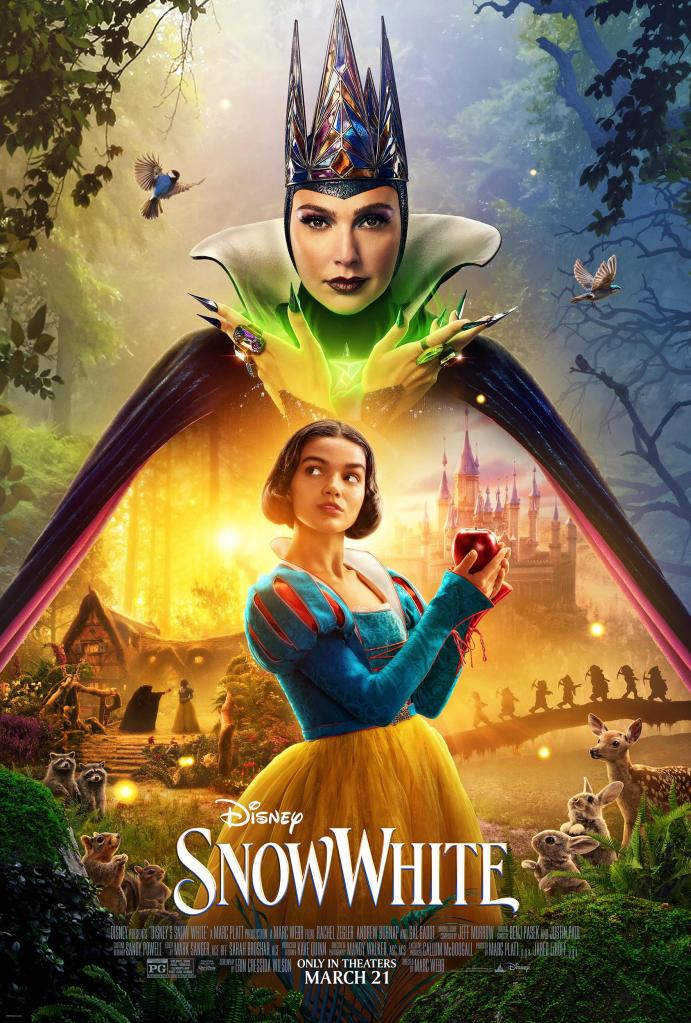
Disney’s latest live-action adaptation, “Snow White,” directed by Marc Webb, arrives amidst a flurry of anticipation and controversy. Starring Rachel Zegler in the titular role and Gal Gadot as the Evil Queen, this reimagining of the beloved 1937 animated classic attempts to modernize the fairy tale for a contemporary audience. However, early reviews indicate a mixed reception, with critics praising some individual performances but largely faulting the film for its narrative changes, visual inconsistencies, and a perceived lack of the original’s enchantment.
The film’s plot largely follows the familiar tale: Snow White, fleeing from the jealous Evil Queen, finds refuge with a group of woodland inhabitants. When palace guards are dispatched to retrieve her, a commoner named Jonathan (Andrew Burnap) and his band of rebels band together to protect her. The core elements of the fairy tale are present, but with significant alterations aimed at updating the story’s themes and character motivations.
One of the most frequently highlighted aspects of the film is Rachel Zegler’s performance as Snow White. Many critics commend her “impressive vocal performance” and “radiant charisma and emotion,” noting that she embodies a “fearless, fair, brave, and true” Snow White. Her singing is consistently praised as a standout element. However, some found her portrayal to lack the “charisma and inspiration” to truly elevate the character, feeling she sometimes came across as “ordinary.”
Gal Gadot’s portrayal of the Evil Queen has garnered a more divided response. While some acknowledged her “beautiful gowns” and a certain “fun” in her performance, others found her acting to be “wooden” and “one-note,” particularly when conveying fury. Her singing voice was also noted as “thin.”
The film’s attempts at modernization and revisionist tweaks have been a major point of discussion. Instead of a passive princess waiting for a prince, this Snow White is depicted with “newfound depth through her fervent desire to become the leader her father believed she could be.” The traditional “prince” character is replaced by Jonathan, a rebel leader, and their relationship evolves into one of “mutual support” rather than immediate romantic rescue. While some reviewers appreciated these updates for a “modern audience,” others felt these changes stripped the story of its essence and made it “unrecognizable” from the original, with the new songs being “bland” compared to the classics.
A significant point of contention revolves around the film’s visuals and production quality. Despite a substantial budget, many critics found the CGI to be “shockingly subpar,” with the enchanted forest looking “artificial” and the CGI creatures lacking the charm of their animated counterparts. The reimagining of the seven dwarfs, now depicted as CGI characters, was a particular source of criticism, described as “creepy,” “weird,” and “horrific,” detracting from the film’s magic. The overall aesthetic is often labeled as “dull,” “uninspired,” and even “plasticky,” leading some to suggest it looks more like a “direct to video” release than a major Disney production.
Ultimately, “Snow White” appears to be a film caught in a difficult balance between honoring a beloved classic and attempting to reinvent it for contemporary sensibilities. While Rachel Zegler’s vocal talents and some of the updated themes found favor with a portion of critics, the film’s inconsistent visuals, narrative changes, and perceived lack of the original’s inherent magic have left many feeling that this live-action adaptation is “unnecessary” and “forgettable.” For some, it reinforces the sentiment that not every animated masterpiece benefits from a live-action remake.

Leave a comment